
August 18, 2026
Friends,
We are excited to share this interview with Edwin Dorsey, founder of The Bear Cave newsletter. I have known Edwin since he was a student at Stanford, when he famously called me to say he was considering dropping out of school to become a short seller. While certainly sympathetic to the idea of leaving college, I told him short selling wasn’t worth dropping out over and he did ultimately graduate! Since then, Edwin has built an impressive track record at a remarkably young age as both an investor and entrepreneur, first becoming a well-known voice on Twitter and then launching The Bear Cave, a newsletter focused on short selling investigations, as well as Sunday’s Idea Brunch and several other research-oriented businesses.
In this interview, we discuss Edwin’s early interest in short selling, his investigations into Care.com and Stanford leadership, and how he built The Bear Cave into a successful subscription business. Edwin shares some of his favorite investigative tools and tricks of the trade as well as lessons from launching his various businesses. We also discuss his recent sale of The Bear Cave to Hunterbrook Media, what comes next, and his growing interest in prediction markets, including his latest project, www.HighgroundResearch.com.
**
I am also excited about Raging Capital Ventures’ upcoming 5th Annual Ideas & Networking Conference on October 1, 2026 at the Standard Hotel – High Line in New York City. We have confirmed four outstanding speakers, including:
- David Orr, founder and CIO of Militia Capital, a top-performing hedge fund, and portfolio manager of the Militia Long/Short Equity ETF (NASDAQ: ORR)
- Meb Faber, host of the acclaimed The Meb Faber Show podcast and co-founder and CIO of Cambria Investment Management, which has over $3 billion in ETF assets under management and is a leader in tax-efficient 351 ETF exchanges
- Robert Robotti, a legendary and well-known value investor who runs Robotti & Co.
- Michael Gibson, co-founder of the 1517 Fund and author of I Will Pay You to Drop Out, who also helped launch the Thiel Fellowship
The event will start with lunch at 12:30 PM and conclude with cocktails on the High Line River Terrace starting at 3:30 PM.
Click here for more information on the Speakers and Agenda and to register.
Space is limited and we expect a sell-out — I hope you can attend!
Enjoy!
Best Regards,
William C. Martin
Topics in this Issue of An Entrepreneur’s Perspective:
- Interview with Edwin Dorsey, Founder of The Bear Cave – The Entrepreneur Behind The Bear Cave Newsletter
- Favorite Podcasts & Media
- Recent Tweets from @RagingVentures
**
Interview with Edwin Dorsey, Founder of The Bear Cave – The Entrepreneur Behind The Bear Cave Newsletter

Welcome! You famously called me a few years back, while still a student at Stanford, and told me you wanted to go into the short selling business — and I clearly failed to dissuade you (but you did at least graduate)! What originally made you interested in the stock market and specifically short selling?
Bill, thank you for having me on your interview series. I am a longtime reader and hope I can meet the very high bar you’ve set with past guests.
I was passionate about stocks from a young age. In third grade, my grandmother put some of her money in an E*TRADE account, gave me the username and password, and let me be her “advisor.” I’ve been hooked ever since. I love math, numbers, learning, independent thinking, and questioning authority or established narratives. Stock research is a great outlet for those passions.
My transition to the short side happened during my senior year of high school and freshman year of college. As I got better at investing, I started advising more family members on stock ideas and was managing my uncle’s retirement account. One of the stocks I invested in was Valeant Pharmaceuticals, which as you know, had major fraud and fell by more than 90%. Losing money for others hurt me emotionally, made me more skeptical, and gave me the desire to do deeper research.
During my freshman year of college, I was introduced to two talented short sellers: Marc Cohodes and Jim Carruthers.
Another young short seller, Chris Drose, introduced me to Marc, who eventually let me visit him on his chicken farm in northern California. Hearing Marc tell tales of all the companies he exposed and seeing him talk for hours to journalists seemed like the coolest job in the world.
Jim found me through an anonymous blog I was writing on Seeking Alpha that his fund, Sophos, had been reading. My location was set as “Stanford, CA” so he invited me to lunch near his Menlo Park offices. He assumed I was a professor or MBA student, so when I showed up as a freshman, he was a little shocked, but we got along, and Jim offered me an internship. I learned a tremendous amount at Sophos and Jim Carruthers was the best boss I could ever ask for.
One of your first investigations was Care.com, which you dug into while still an undergraduate. Another one of your early investigations, which turned into your “They Must Resign” campaign, was into Stanford’s President and Provost. Can you tell us about these initial efforts?
During my first summer break, I went home for a few weeks and one of my friends told me she had been a babysitter on Care.com and believed the platform had a lot of safety issues. Armed with my investigative skills learned at Sophos, I started digging in. First, I looked at local news stories of Care.com babysitters who had harmed kids (many had prior criminal records). I also found lawsuits alleging failures of Care.com’s background check process.
Naturally, I decided to test Care.com’s background check process out for myself by applying to be a babysitter as Harvey Weinstein. I used a bunch of fictional information, including the email HarveyTheBabysitter@gmail.com and a photo of Weinstein and consented to the background check. Two days later, I received an email saying I was approved. Uh oh!
I wrote an initial report and tweeted about my findings.
That would have been the end of my efforts, except the company decided to call Stanford to try to get me in trouble. To my amazement, Stanford sided with the company and the Dean of Students and Chief Information Officer met with me and asked me to take my article down, claiming I violated Care.com’s terms of service while using Stanford Wi-Fi.
I refused and instead dug deeper. I filed public record requests with every single state attorney general for consumer complaints against Care.com, I went to the NYPD and got call logs mentioning Care.com, and I cold emailed roughly 100 journalists about the safety issues. One of them, Gregory Zuckerman at the Wall Street Journal, took me seriously and ultimately wrote a front-page story about Care.com’s safety issues. Care.com’s CEO, CFO, and General Counsel ultimately resigned and the company was bought out about 40% below its highs.
The Care.com experience gave me credibility on Twitter and showed me how independent journalism could make a difference.
The experience also shook my faith in higher education and led me to become critical of Stanford’s President and Provost. I believe they acted unethically in their treatment of students and coverups of misconduct.
During their tenure, I calculated that Stanford’s student death rate was roughly 500% above its historical average, an increase I believe was due to policies and people promoted by President Tessier-Lavigne’s administration. For example, an administrator President Tessier-Lavigne appointed to lead student well-being initiatives was simultaneously operating a college-admissions consulting business that offered a $4,500 package for “intensive individualized college admissions assistance.”
Interested readers can learn more on my website TheyMustResign.com, in the Wall Street Journal’s article “‘Stanford Hates Fun’: Students Revolt After Tree Mascot Suspension,” and in How to Rule the World: An Education in Power at Stanford University, a book by Stanford student Theo Baker on the failures of President Tessier-Lavigne and Provost Drell.
In February 2020, you successfully launched The Bear Cave newsletter. Tell us about your idea for the newsletter and how you were able to get traction. How many companies have you profiled over the years and what are some of your favorite highlights?
I really wanted to work for Sophos out of college. However, Jim was in the early process of retiring, so I needed to find a new option. I decided to start The Bear Cave in February 2020, my senior year, for two reasons.
First, it was hard to keep up with all the activist short campaigns and short-seller news. There are a lot of activists, many with smaller followings, and I wished there was a weekly summary of the activist short news. So, I decided to create one, assuming other people had the same issue.
Second, I thought launching a newsletter would help me get noticed and hired on favorable terms at a hedge fund.
I was extremely lucky with timing as the pandemic was the best time ever to launch an email newsletter. People were online, bored, had a ton of free time, had extra disposable income, and the market was very volatile. I got early traction on Twitter, and because of my Care.com experience hedge funds cared about my opinions. In addition, I cold emailed every college investment group, DM’d each of my ~10,000 Twitter followers, and would send my newsletter to anyone I thought might like it. I learned that lists like “The 50 best accounts for stock ideas on X” or lists of research tools were a great way to go viral.
Within six months of launching, I had 3,000 free emails, and within six weeks of launching a paid tier, The Bear Cave was doing over $100,000 in ARR.
I’ve published on roughly 100 companies over the last six years. Some of my favorite investigations were on safety issues at Roblox, billing issues at Planet Fitness, and franchise health and billing issues at The Joint.
Do you have any favorite ideas that you have written about more recently that you think may still be timely?
Yes, I have two!
In my opinion, DraftKings (NASDAQ: DKNG) is in a lot of long-term trouble because of prediction markets, which have several structural advantages. Many admit users at age 18, can reach customers beyond traditional sportsbook jurisdictions, and are distributed through third-party interfaces such as Robinhood. They also have a superior model often with better prices, no betting limits, and no desire to ban winning bettors.
In addition, prediction markets have billions in VC dollars to spend on acquiring new customers, and some operators, such as Novig, are targeting DraftKings’ core base of recreational bettors.
The competitive dynamic between prediction markets and DraftKings reminds me of Netflix versus Blockbuster in the mid-2000s.
Second, Serve Robotics (NASDAQ: SERV) makes small self-driving robots for food delivery. Restaurants put Uber Eats or DoorDash orders in the robots, it drives on the sidewalk, and then arrives at your house or building where you walk out and open it via app to get your food. Serve robots are a major presence in my neighborhood of Brickell.
The issue is no one likes them. Restaurants are inconvenienced by needing to send staff out to load the robots; pedestrians don’t like them because they block sidewalks, block traffic, get run over by trains, and sometimes break down or get stuck; and customers don’t like them because they take a long time and require you to walk outside in a timely manner to get your food.
In addition, the company needs to hire remote employees to monitor the robots and send U-Hauls to drop them off and pick them up every morning and evening for cleaning and recharging. The model makes no sense and most of these robots sit idle outside my neighborhood Publix.
This company is a consistent money loser with no path to profitability. I consider Serve a well-intended experiment that has failed.
Unlike many others who write about shorts, you don’t actually short the companies you write about and only make money from subscriptions. Can you share your rationale for this approach?
When starting my newsletter in February 2020, I believed the regulatory landscape for activist shorts was unclear. One helpful experience was a college internship I had in the SEC Enforcement Division. While there, I asked staff many hypothetical questions and was surprised at how much was vague or open to interpretation.
Because of this, I was afraid to follow the activist short model. I believe not taking positions is better from a regulatory perspective, lowers my risk of being sued, is more ethical/journalistic, and makes me more credible.
You’ve had great success identifying bad companies, including using tools like FOIA requests, Glassdoor data, PCAOB audit partner databases, and the like. Can you share some of your favorite tricks of the trade?
I’m amazed that more researchers don’t file public record requests. I filed 100s of these requests, if not 1,000s.
In my opinion, the Texas Attorney General and Florida Attorney General are the two best regulators when it comes to using public records requests to get consumer complaints. They are large states (so have a lot of complaints) and are also very responsive (think two weeks vs New York, which takes six months). I would send an email for “copies of all consumer complaints, and any related correspondence, made to the [State] Attorney General’s office that reference [Company] Inc (“[Company]”) from [start date] to [end date].”
After a few weeks, I would get a PDF with dozens or even hundreds of complaints, and potentially letters between the state AG and subject company. FOIA is amazing, free or cheap, and once you get the hang of it, takes only a few minutes.
Glassdoor is also underrated and misused.
Here’s what not to do: make a table with companies and their average Glassdoor ratings and assume higher average ratings mean a better culture. That’s flawed for several reasons. Companies can game the system by paying Glassdoor or encouraging employees to leave positive reviews. And low averages can be due to potentially good things, like layoffs at a bloated company, or a move to in-person work in a remote work company.
Instead, look through every review chronologically and focus on content, not the rating. In particular, look at what salespeople are saying. I believe 90% of the value of Glassdoor reviews comes from the salespeople.
Is the product easy to sell? Are there a lot of dissatisfied customers? Are you getting yelled at by unhappy customers? Is management pressuring you to lie? Are you hitting targets and getting bonuses?
Finally, more investors should try to follow local news reporting. Typically, before something is a national scandal, there will be a lot of local news stories on the issue. The best way to find local news stories buried deep in Google is to filter results by year and go year by year (or month by month) through old search results.
You are also an impressive entrepreneur, having launched tools like StockPromotionTracker.com, FOIAsearch.com, and the Sunday’s Idea Brunch newsletter. Can you tell us a bit about these projects and how you have approached launching new businesses?
You are quite kind Bill! I’ve also had a lot of failed experiments like CoolStockTweets.com and BullpenCareers.
Typically, I see a problem I want solved for myself. For example, with StockPromotionTracker.com, I wished there was a database that tracked all paid stock promotion campaigns as it would be good for short idea generation.
Then, I work with an engineer to help build the product.
After the product is built, I leverage my existing distribution, The Bear Cave newsletter and Twitter, to help build initial traction and iterate from there. I typically try to keep prices low, offer free trials, or offer a lot for free to build early traction.
The ideas typically need to be easy to start and easy to fail, then I can double down on what’s working and cut what isn’t.
I would also point out that it was easy to launch my Sunday’s Idea Brunch interview series newsletter because my first guest was particularly excellent: you!
Most recently, you agreed to sell The Bear Cave to Hunterbrook Media (www.hntrbrk.com), a well-known short selling activism firm. Congrats! Can you share details on this decision and what the future holds for you?
I loved writing The Bear Cave. However, writing a newsletter well is a full-time job and your heart has to be in it. If not, readers can tell.
In the last year or so, I started to become more excited by prediction markets and various entrepreneurial ventures and a little disillusioned with traditional finance and activist short selling. It got to a point where I would spend 40+ hours a week on prediction markets and viewed The Bear Cave as more of a burden than a passion. So, I began to think of what a post-Edwin version of The Bear Cave would look like.
Hunterbrook has done some amazing activist work and has a young, driven, and talented team. In addition, they share my love of exposing bad actors and building a better world through good journalism about issues that impact everyday Americans. A great example is Hunterbrook’s investigation into nursing home operator Ensign (NASDAQ: ENSG): https://hntrbrk.com/investigations/ensign
I quickly realized Hunterbrook would be the best home for The Bear Cave, and was very lucky they wanted to partner. I’m in an advisory role now and am rooting hard for their success with The Bear Cave.
On the personal side, I’ve got about a year and a half before I turn 30. My top priorities during this time are (1) get in great physical shape and (2) have a ton of fun. Now that I have more free time, I’m traveling more, socializing more, walking more, reading more, and spending more time on boats and beaches. Brickell, Miami is a fun place and I’m just enjoying life.
Longer term, I am obsessed with prediction markets and could eventually see myself drifting back toward corporate accountability. However, if I did more journalism in the future, it would probably be in video form, with no paywalls, and geared toward a mass market audience.
You told me you are spending a lot of time on prediction markets lately, including soft launching www.highgroundresearch.com. Tell us more!
Prediction markets will be one of the most important innovations of my generation. I segment individual prediction markets into three categories:
1. Novelty markets (e.g., “What color Gatorade will be used in the Super Bowl Gatorade shower?”). These serve an entertainment purpose.
2. Markets with media value (e.g., “Will the Save Act be passed into law by year-end?”) These markets are a form of media and can help people make better decisions. Other examples are markets on whether a war will start/when it will end or whether a specific drug will be approved.
3. Markets with financial hedging value (e.g., Will the Fed raise interest rates? Will NOAA record a Category 4 or above hurricane in Florida this year?)
I see these as the highest volume prediction markets in the future, with a big impact on insurance and finance.
I see a world in ten years where Americans go to Kalshi and Polymarket to understand the world before going to the newspapers. I imagine a future where an “expert” is someone who consistently outperforms the prediction markets, rather than someone with a certain educational pedigree who sounds smart on TV. I predict that millions of Americans will buy hurricane, flood, or wildfire insurance on prediction markets specialized to their Sub-ZIP codes with resolution based on hyperlocal weather data. I hope valuable data on future markets like “Which degree will be highest paying in 2035?” or “Which cities will have >4% GDP growth?” will help people make better decisions about what to study or where to live.
I’m an active and consistently profitable trader on Kalshi and see tremendous opportunity to build out a successful trading operation, a new prediction market focused newsletter, and prediction market research tools on my platform HighgroundResearch.com. Let’s revisit in five years and see how I did!
Thank you and good luck!
**
General David Petraeus: The Future of Warfare
General David Petraeus, the former commander of U.S. forces in Iraq and Afghanistan and former CIA Director, provides a fascinating overview of how drones and autonomous systems are reshaping modern warfare, drawing on multiple recent trips to Ukraine. Among the more striking statistics: Ukraine reportedly achieves a 90–95% drone interception rate on many nights, has produced roughly seven million drones this year, and has destroyed approximately one-third of the Russian navy despite having virtually no navy of its own.
Petraeus argues that the West has not yet fully absorbed the lessons from Ukraine. Inexpensive drones, fiber-optic-guided systems, and increasingly autonomous weapons are fundamentally changing the nature and economics of warfare and could eventually replace many traditional armored formations. More broadly, I found the discussion to be a compelling real-world example of how quickly innovation and AI are being deployed on the battlefield.
Lambda Labs: Building the AI Cloud
This is a fascinating interview with Stephen Balaban, co-founder and CTO of Lambda Labs, one of the leading “neocloud” providers focused on AI infrastructure. Lambda has quietly grown into a business reportedly operating at roughly a $1 billion annual revenue run rate. (Full disclosure: I am an early investor in Lambda through 1517 Fund, so I have followed the company’s progress closely.)
The discussion covers the explosive growth in AI infrastructure, why specialized AI cloud providers are able to compete effectively with the hyperscalers, and how demand for GPU compute continues to outstrip supply. Balaban also discusses the evolution from training to inference workloads and why he believes we are still in the early innings of AI infrastructure investment. If you’re interested in where AI compute is headed over the next several years, I think this interview is well worth your time.
The Tim Ferriss Show: Interview with Graham Duncan, Talent is the Best Asset Class
This is an outstanding conversation with Graham Duncan, founder of East Rock Capital (a family office managing money for Lennar’s Stuart Miller, among others), with a focus on one of the most important topics in investing: how to identify exceptional people. Duncan argues that talent is the highest-return asset class and explains why the best investors often differentiate themselves through their ability to recognize extraordinary founders, CEOs, investors, and operators before the rest of the market.
The discussion covers Duncan’s framework for evaluating talent, the importance of reference checks over interviews, how credibility and trust compound over a career, and why long-term relationships create durable investment advantages. He also shares practical insights on improving judgment, avoiding cognitive traps, and making better decisions under uncertainty. I found it to be one of the more insightful interviews on the human side of capital allocation and business success.
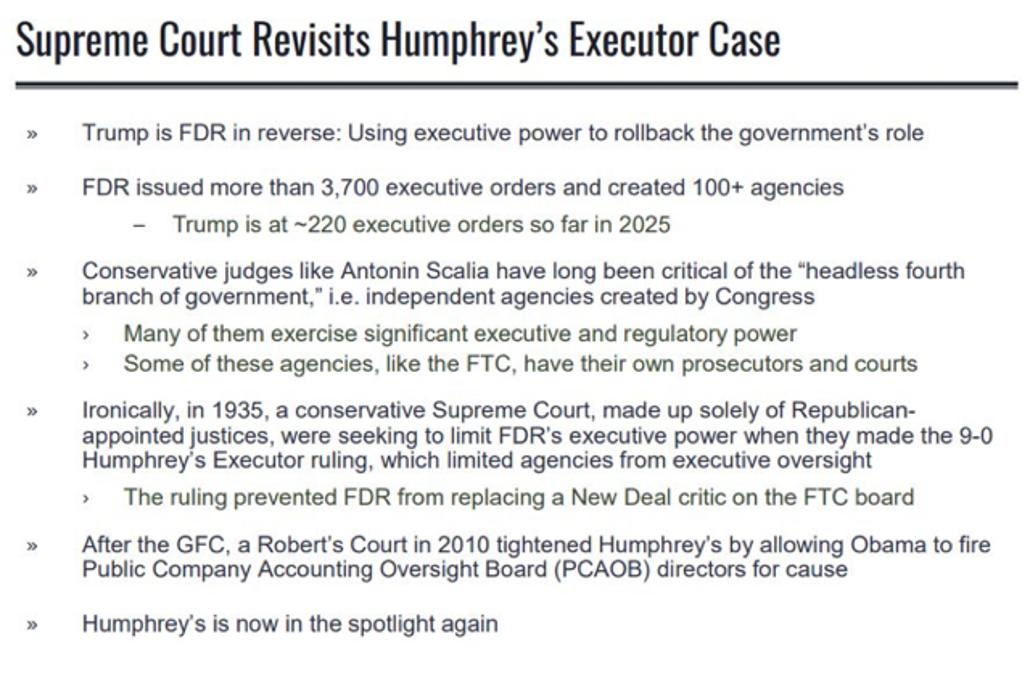
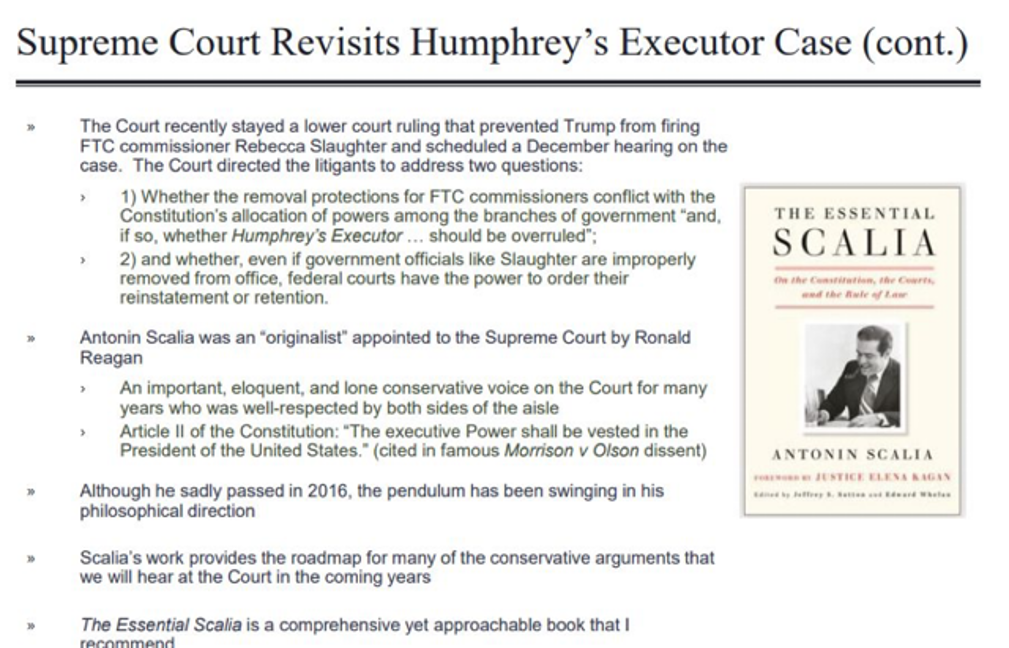
The End of Humphrey’s Executor
I’ve written previously that Humphrey’s Executor was one of the most important Supreme Court precedents that most investors had never heard of because it insulated so-called “independent” agencies – including the SEC, FTC, FCC, and others – from direct presidential control.
The Supreme Court recently overturned the 1935 decision, with Chief Justice Roberts writing that if anything more was left of Humphrey’s, the Court was overruling it. While the Court preserved a narrow exception for the Federal Reserve, the decision represents one of the most significant shifts in the balance of power between the Executive Branch and the administrative state in nearly a century. The ruling also vindicates Justice Antonin Scalia’s lone dissent in Morrison v. Olson (1988), where he warned against creating a “headless fourth branch” of government that exercises executive power without Presidential oversight.
Since the New Deal, Congress has created a sprawl of agencies that now regulate every inch of our lives and economy. My thesis is that by re-imposing executive oversight over these agencies, which is proper under the Constitution, we will make government more responsive to the people and the people more free. I also think it will spark Congress to get back in the old business of making laws themselves and/or (even better) winding down many of these regulatory behemoths, particularly if they don’t like the executive du jour overseeing them.
I would encourage readers interested in constitutional law to read the Supreme Court’s opinion, which is remarkably readable.
Supreme Court opinion: https://www.supremecourt.gov/opinions/25pdf/25-332_qn12.pdf
Prior Slides on Humphrey’s Executor from our Fall 2025 Conference:
**
A Selection of Recent Tweets from @RagingVentures:
OpenAI “ARR” apparently run rating at $60 b, and (for the most part) they haven’t yet monetized their 1 billion weekly consumer actives. Bullish $ORCL. https://t.co/pBDIrTTAqV
— Raging Capital Ventures (@RagingVentures) August 1, 2026
Some thoughts of mine on Archegos from May 2021 (below).
Was Leopold using swaps? The value of Situational’s reported Q1 13F holdings pale in comparison to some of the exposure numbers being mentioned today, even adjusting for appreciation.
I would observe that once Archegos…
— Raging Capital Ventures (@RagingVentures) July 30, 2026
The capex spend is mind boggling, but I held my nose and bought $META today around $590-600
I don’t how the AI bet will shake out, but I do know that…
– $META Reels is sucking up engagement share from everyone, even $NFLX
– $GOOG search refers are in free fall, which should…
— Raging Capital Ventures (@RagingVentures) July 28, 2026
Despite my past skepticism, $GLW around its current $125 per share ($110 b cap) actually seems fairly compelling given the company’s scale, leading market position, and multi-year growth ramp.
— Raging Capital Ventures (@RagingVentures) July 29, 2026
$AGYS does not see negative impact of AI on enterprise software companies, argues that they are "seeing the opposite effect." Also notes the cost/benefit analysis favors software subscriptions vs. investing in expensive AI development. pic.twitter.com/W4qnsF26r4
— Raging Capital Ventures (@RagingVentures) July 28, 2026
I’m now very bullish on $CMCSA as well.
In my view, Peacock/NBCU/theme parks are likely worth around the current market cap alone.
Importantly, Peacock / NBC are now competitively advantaged in sports media thanks to a superior combination of reach with their NBC broadcast… https://t.co/6KnlJzQMsn
— Raging Capital Ventures (@RagingVentures) July 28, 2026
Daniel Loeb-esque activism at $CODI by @Adam_Wyden
The review of the board members in the second half of the letter is quite something
Full letter:https://t.co/l10bkeYPOp https://t.co/slHEIjmDmT
— Raging Capital Ventures (@RagingVentures) July 17, 2026
Gavekal’s Louis-Vincent Gave is always worth a listen for his cogent and insightful macro perspectives. In this discussion, he covers AI capex, signs that the Chinese real estate market may be bottoming, and the potential for Japanese investors to begin repatriating their… https://t.co/9Bg95S9pD1
— Raging Capital Ventures (@RagingVentures) July 14, 2026
VAR is the Brussels of soccer officiating
— Raging Capital Ventures (@RagingVentures) July 11, 2026
Excited to see Elroy Air going public via SPAC with $CMII / $IPXG…
Elroy has developed a hybrid-electric, autonomous VTOL aircraft called Chaparral that has both military and defense applications.
We have invested in multiple rounds at Elroy, starting with their seed in 2018.…
— Raging Capital Ventures (@RagingVentures) July 9, 2026
I think $CHTR stock goes higher in all three of these scenarios, as there are strong constituencies rooting for each:
– Suspending buybacks to reduce debt
– Initiating a large dividend and using the remaining cash flow to pay down debt
– Continuing aggressive stock buybacks
— Raging Capital Ventures (@RagingVentures) June 23, 2026
I purchased a large amount of $CHTR equity and medium-dated calls this past week
Stock is left for dead at $145
Enormous FCF which is inflecting higher as capex declines, $50 per share or more in sight for 2028
Competition is intense but strong wireless upsells provide an… https://t.co/fOZ5l36dPH
— Raging Capital Ventures (@RagingVentures) May 24, 2026
Recently had dinner with a senior innovation strategy exec that works at a large pharma company near me…
Usually somewhat of a skeptic, she noted AI is already having a positive impact on their drug discovery and development processes, with machines willing to suggest very…
— Raging Capital Ventures (@RagingVentures) June 18, 2026
Like many of his policies, Bernanke’s idea to host press confs and provide “forward guidance” was a mistake. Powell should do away with both and stop spoon feeding investors. Inject uncertainty back into the markets. This, in turn would create a healthier & more resilient system.
— Raging Capital Ventures (@RagingVentures) September 21, 2022
My favorite SaaS names at the moment: $WDAY, $HUBS, $BILL, and $ESTC.
I bought more $HUBS and $BILL today.
These stocks are very volatile so I've been very active at times in writing covered calls or shorting puts, and then trading around those positions.
— Raging Capital Ventures (@RagingVentures) June 9, 2026
Pleased to have invested (a small sum) in Anthropic’s 2023 Series C financing at a $4.1 b pre-money valuation via an AngelList syndicate
Knock on wood – let’s get it public! https://t.co/MW8VKp58iM
— Raging Capital Ventures (@RagingVentures) February 13, 2026
Run, don't walk, to listen to this interview if you're investing in memory $MU $SNDK
NVDA's Ross argues that if memory prices stay high, engineers will devote a large portion of their time to solving the problem by using less memory https://t.co/Xn5QqhtvOe
— Raging Capital Ventures (@RagingVentures) May 19, 2026
**
“We hold these truths to be self-evident, that all men are created equal, that they are endowed by their Creator with certain unalienable Rights, that among these are Life, Liberty and the pursuit of Happiness.” – Thomas Jefferson